7.3.1 Spatial Filtering 空间滤波[cfd-7-3-1]
LES基于空间滤波(spatial filtering)操作,它把任意流动变量\(U\)分解为滤波后(大尺度、可解析)的部分\(\overline{U}\)与亚滤波(不可解析)的部分\(U'\),即en
LES is based on a spatial filtering operation, which decomposes any flow variable \(U\) into a filtered (large-scale, resolved) part \(\overline{U}\) and into a sub-filter (unresolved) part \(U'\), i.e.,
空间中\(\vec{r}_0\)处的滤波变量定义为en
The filtered variable at the location \(\vec{r}_0\) in space is defined as
其中\(\Omega\)表示整个流动域,\(G\)表示滤波函数,\(\vec{r}\)为位置向量。滤波函数决定小尺度的结构与大小,它依赖于差\(\vec{r}_0 - \vec{r}\)以及滤波宽度\(\Delta = \left(\Delta_1\,\Delta_2\,\Delta_3\right)^{1/3}\),\(\Delta_i\)为第\(i\)个空间坐标方向的滤波宽度。最常用的滤波函数有如下几种(见图7.3):
- tophat(盒式)滤波:
- 锐利傅里叶截断滤波:
- Gaussian滤波:
en
where \(\Omega\) denotes the entire flow domain, \(G\) represents the filter function, and \(\vec{r}\) is the position vector, respectively. The filter function determines the structure and size of the small scales. The filter function depends on the difference \(\vec{r}_0 - \vec{r}\) and on the filter width \(\Delta = \left(\Delta_1\,\Delta_2\,\Delta_3\right)^{1/3}\), with \(\Delta_i\) being the filter width in the \(i\)-th spatial coordinate. The following filter functions are the mostly used ones (see Fig. 7.3):
- the tophat filter:
- The sharp Fourier cut-off filter:
- The Gaussian filter:
tophat滤波和Gaussian滤波会平滑大尺度脉动以及滤波宽度以下的小尺度。截断滤波只影响截止波数以下的尺度。实际中,Gaussian滤波总是与锐利傅里叶截断配合使用。适用于单元尺寸变化的网格的滤波函数见文献[114]、[115]。en
The tophat and the Gaussian filter smooth the large-scale fluctuations as well as the small scales below the filter width. The cut-off filter affects only the scales below the cut-off wave-number. In practice, the Gaussian filter is always employed in conjunction with a sharp Fourier cut-off. Filters suitable for grids with varying cell sizes were proposed in Refs. [114], [115].
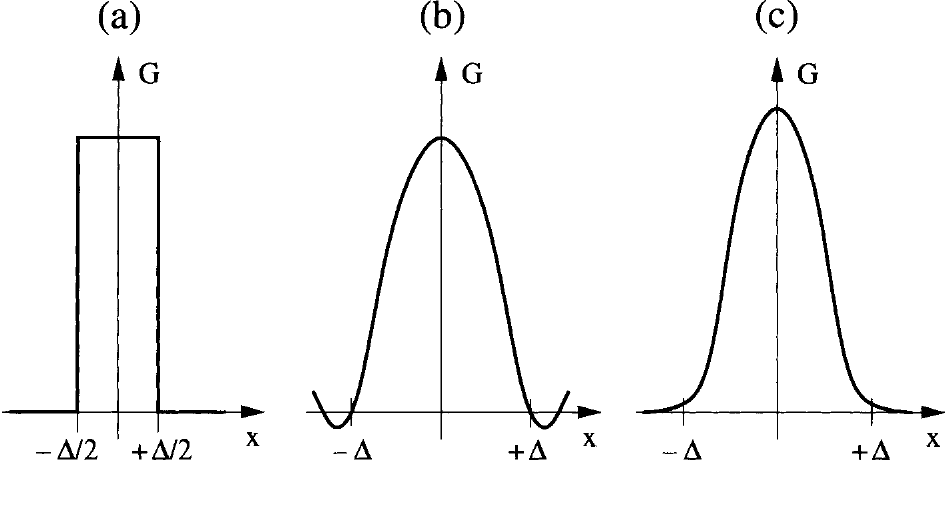
图7.3:物理空间中的LES滤波函数:tophat (a),cut-off (b),Gaussian (c)。图例:G——滤波函数;x——空间坐标;\(-\Delta/2\)、\(+\Delta/2\)——tophat滤波的支撑区间;\(-\Delta\)、\(+\Delta\)——滤波宽度标记。