7.1.1 Reynolds Averaging 雷诺平均[cfd-7-1-1]
对湍流进行近似处理的第一种方法由Reynolds于1895年提出。该方法基于把流动变量分解为平均值与脉动值两部分。随后求解控制方程(7.1)的平均值——平均值对工程应用最有意义。这样,首先考虑不可压缩流动,方程(7.1)中的速度分量和压力用下式替代[13]en
The first approach for the approximate treatment of turbulent flows was presented by Reynolds in 1895. The methodology is based on the decomposition of the flow variables into a mean and a fluctuating part. The governing equations (7.1) are then solved for the mean values, which are the most interesting for engineering applications. Thus, considering first incompressible flows, the velocity components and the pressure in Eq. (7.1) are substituted by [13]
其中平均值用上划线表示,湍流脉动用撇号表示。平均值通过平均过程求得。雷诺平均(Reynolds averaging)有三种不同的形式:en
where the mean value is denoted by an overbar and the turbulent fluctuations by a prime. The mean values are obtained by an averaging procedure. There are three different forms of the Reynolds averaging:
1. 时间平均(time averaging)——适用于定常湍流(统计定常湍流)en
1. Time averaging -- appropriate for stationary turbulence (statistically steady turbulence)
其结果是,平均值\(\bar{v}_i\)不随时间变化,而只随空间变化。情形如图7.2所示。实践中,\(T\to\infty\)意味着时间间隔\(T\)应远大于湍流脉动的典型时间尺度。en
As a consequence, the mean value \(\bar{v}_i\) does not vary in time, but only in space. The situation is sketched in Fig. 7.2. In practice, \(T\to\infty\) means that the time interval \(T\) should be large as compared to the typical time-scale of the turbulent fluctuations.
2. 空间平均(spatial averaging)——适用于均匀湍流en
2. Spatial averaging -- appropriate for homogeneous turbulence
其中\(\Omega\)为控制体。此时\(\bar{v}_i\)在空间上均匀,但允许随时间变化。en
with \(\Omega\) being a control volume. In this case, \(\bar{v}_i\) is uniform in space, but it is allowed to vary in time.
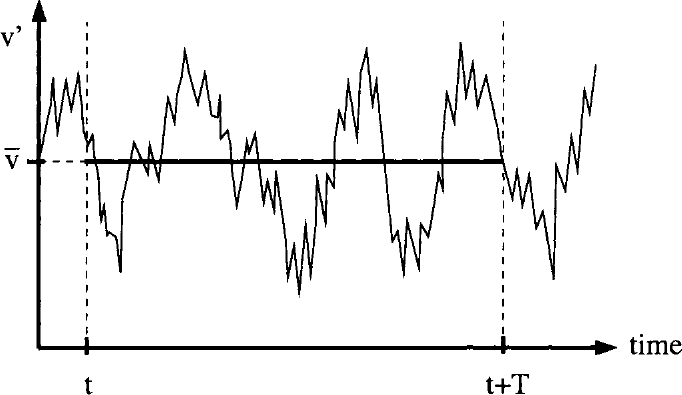
图7.2:雷诺平均——湍流速度脉动\(v'\)与统计平均值\(\bar{v}\)的示意图。
3. 系综平均(ensemble averaging)——适用于一般湍流en
3. Ensemble averaging -- appropriate for general turbulence
这里,平均值\(\bar{v}_i\)仍然是时间和空间坐标的函数。en
Here, the mean value \(\bar{v}_i\) still remains a function of time and of space coordinates.
对所有这三种方法,脉动部分的平均值都为零,即\(\overline{v'_i}=0\)。然而,容易看出\(\overline{v'_iv'_i}\neq 0\)。若两个湍流速度分量相关,则对\(\overline{v'_iv'_j}\)同样如此。en
For all three approaches, the average of the fluctuating part is zero, i.e., \(\overline{v'_i}=0\). However, it can be easily seen that \(\overline{v'_iv'_i}\neq 0\). The same is true for \(\overline{v'_iv'_j}\), if both turbulent velocity components are correlated.
当湍流既是定常的又是均匀的时候,三种平均形式彼此等价。这称为各态历经假设(ergodic hypothesis)。en
In cases where the turbulent flow is both stationary and homogeneous, all three averaging forms are equivalent. This is called the ergodic hypothesis.