9.1 Local Time-Stepping 局部时间步长[cfd-9-1]
在这种情形下,离散化的控制方程(6.1)对每个控制体都用尽可能大的时间步长进行积分。局部时间步长\(\Delta t_I\)按式(6.14)、(6.18)、(6.20)或(6.22)之一计算。这样一来,向定常态的收敛会显著加速,但瞬态解不再具有时间上的精度。图9.1以绕机翼的无黏亚声速流动为例,展示了局部时间步长的效率。流动由显式多级格式(6.1.1小节)推进到定常态。显然,采用全局时间步长(即对所有控制体都相同的时间步长)会导致向定常态不必要地缓慢收敛。对于定常黏性流动,通常还能获得更大的CPU时间节省。en
In this case, the discretised governing equations (6.1) are integrated using the largest possible time step for each control volume. The local time step \(\Delta t_I\) is calculated according to one of the formulae (6.14), (6.18), (6.20), or (6.22). As a result, the convergence to the steady state is considerably accelerated, however the transient solution is no longer temporally accurate. The efficiency of the local time-stepping is demonstrated in Fig. 9.1 for an inviscid subsonic flow past a wing. The flow is driven to the steady state by an explicit multistage scheme (Subsection 6.1.1). It is apparent that using a global time step (i.e., a time step identical for all control volumes) results in an unnecessarily slow convergence towards the steady state. Even larger savings in terms of the CPU-time are usually achieved for stationary viscous flows.
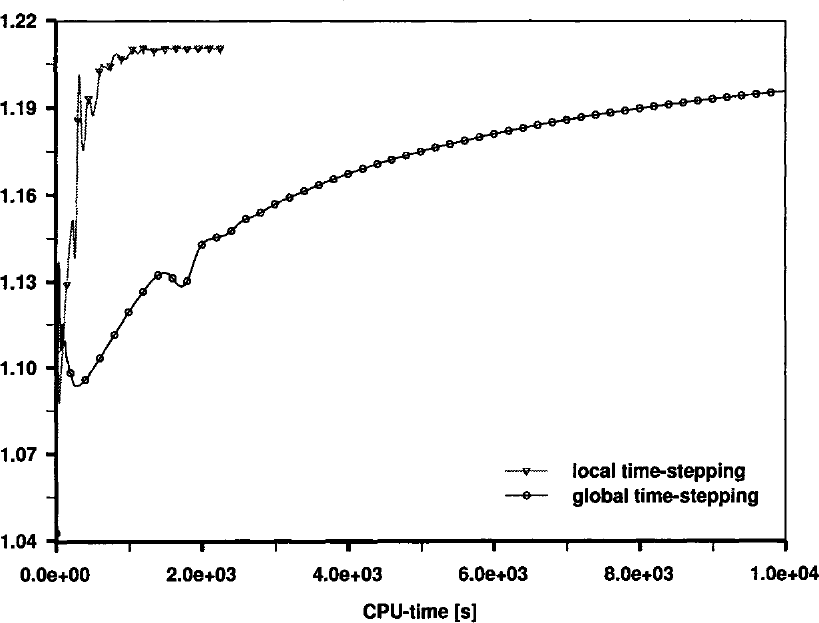
图9.1:非结构网格上无黏亚声速流动有/无局部时间步长时升力系数收敛历史的比较。纵轴:升力系数(lift coefficient);横轴:CPU时间(CPU-time [s]);图例:local time-stepping——局部时间步长;global time-stepping——全局时间步长。