8.8 Periodic Boundaries 周期边界[cfd-8-8]
在某些实际应用中,流场相对于一个或多个坐标方向是周期性的。在这种情况下,只需在其中一个重复区域内模拟流动即可,而与其余物理域的正确相互作用则通过周期边界条件来保证。en
There are certain practical applications where the flow field is periodic with respect to one or multiple coordinate directions. In such a case, it is sufficient to simulate the flow only within one of the repeating regions. The correct interaction with the remaining physical domain is enforced via periodic boundary conditions.
周期边界可以分为两种基本类型。第一种是平移周期性(translational periodicity),即一个周期边界通过纯粹的坐标平移就能变换成另一个边界。第二种类型是由坐标旋转生成的周期边界,因此我们称之为旋转周期性(rotational periodicity)。en
We can distinguish between two basic types of periodic boundaries. The first one covers translational periodicity. This means that one periodic boundary can be transformed into the other boundary by pure coordinate translation. The second type represents periodic boundaries, which were generated by coordinate rotation. Thus, we speak of rotational periodicity.
下面我们将描述单元中心格式和单元顶点格式中周期边界条件的实现,并讨论旋转周期性的情形。关于周期边界处理的更多细节可参见文献[37]、[38]。en
In the following, we shall describe the implementation of the periodic boundary conditions for the cell-centred and the cell-vertex scheme. We shall also consider the case of rotational periodicity. Further details of the treatment of periodic boundaries can be found in Refs. [37], [38].
Cell-Centred Scheme 单元中心格式
利用虚单元概念可以简单地实现周期边界条件。让我们考察图8.10中来自叶轮机械的例子。该构型在竖直方向上是周期的。阴影单元1和2分别位于下部和上部周期边界上。根据周期性条件,第一层虚单元对应于对面周期边界上的边界单元,第二层虚单元与第二层物理单元通信,依此类推。于是,虚单元中所有标量(密度、压力等)都直接取自相应的物理单元,即en
The utilisation of the dummy-cells concept enables a simple implementation of the periodic boundary condition. Let us consider the example from turbomachinery in Fig. 8.10. The configuration is periodic in the vertical direction. The shaded cells 1 and 2 are located on the lower and the upper periodic boundary, respectively. Due to the periodicity condition, the first dummy-cell layer corresponds to the boundary cells at the opposite periodic boundary. The second dummy-cell layer communicates with the second layer of the physical cells and so on. Hence, all scalar quantities (density, pressure, etc.) in the dummy cells are obtained directly from the corresponding physical cells, i.e,
在平移周期性的情形下,同样的关系对向量量(速度、梯度)也成立。旋转周期边界则要求对向量变量作修正,这将在下文进一步讨论。en
The same relations hold also for the vector quantities (velocity, gradients) in the case of translational periodicity. Rotational-periodic boundaries require a correction of the vector variables. This will be discussed further below.
Cell-Vertex Scheme (Dual Control Volume) 单元顶点格式(对偶控制体)
情形如图8.11所示。处理周期边界的一种方法是绕阴影控制体的各个面积分通量,然后把图8.11中点1和点2处的残差相加,以得到完整的净通量,即en
This situation is sketched in Fig. 8.11. One approach for the treatment of periodic boundaries consists of the integration of the fluxes around the faces of the shaded control volumes. The residuals at the points 1 and 2 in Fig. 8.11 are then summed in order to obtain the complete net flux. Thus,
点1和点2处的部分控制体(图8.11中的阴影部分)也必须相加。在平移周期性的情形下,来自对面边界的残差保持不变,即\(\vec{R}_{1'}=\vec{R}_1\)和\(\vec{R}_{2'}=\vec{R}_2\),由此得到\(\vec{R}_{1,sum}=\vec{R}_{2,sum}\)。旋转周期边界则要求先对动量方程作变换,然后才能应用式(8.43)。en
The partial control volumes at the points 1 and 2 (shaded in Fig. 8.11) have to be added up as well. In the case of translational periodicity, the residuals from the opposite boundary remain unchanged, i.e., \(\vec{R}_{1'}=\vec{R}_1\) and \(\vec{R}_{2'}=\vec{R}_2\). This results in \(\vec{R}_{1,sum}=\vec{R}_{2,sum}\). Rotationally periodic boundaries require a transformation of the momentum equations before Eq. (8.43) can be applied.
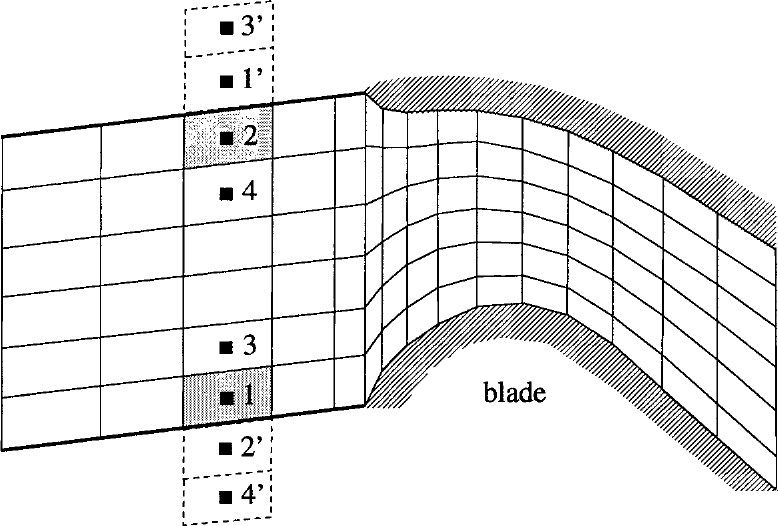
图8.10:二维非结构/结构网格、单元中心格式情形下的周期边界(粗线)。虚单元(虚线)用相应物理单元的(带撇)编号标记。
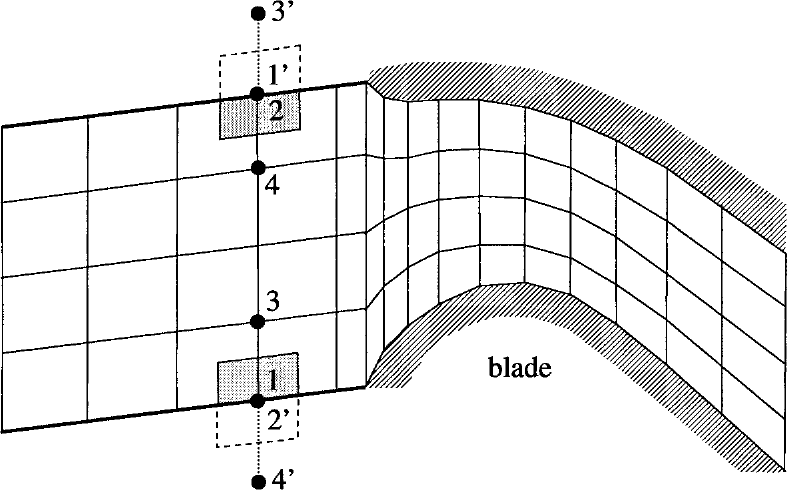
图8.11:二维非结构/结构网格、带对偶控制体的单元顶点格式情形下的周期边界(粗线)。控制体的“虚”部分(虚线)用对面边界上相应控制体的(带撇)编号标记,虚点3'和4'亦同。
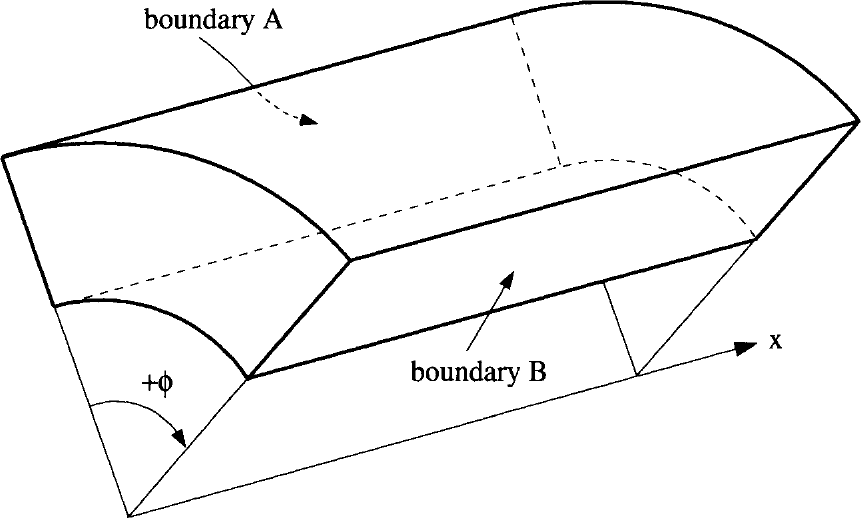
图8.12:旋转周期边界(A与B)。假设旋转轴与\(x\)轴重合。
Rotational Periodicity 旋转周期性
旋转周期条件基于坐标系的旋转。因此,所有向量量(如速度以及标量的梯度)都必须相应地变换;而压力、密度等对坐标旋转不变的标量则保持不变。如果我们假设旋转轴平行于\(x\)轴(见图8.12),则旋转矩阵为en
The rotational periodicity condition is based on a rotation of the coordinate system. Therefore, all vector quantities like velocity or gradients of scalars have to be transformed accordingly. Scalar quantities like pressure or density, which are invariant with respect to coordinate rotation, remain unchanged. If we assume the rotational axis is parallel to the \(x\)-axis (see Fig. 8.12), the rotation matrix becomes
其中周期边界\(A\)与\(B\)之间的角度\(\phi\)以顺时针方向为正。因此,例如从边界\(A\)变换到边界\(B\)的速度向量(图8.10中的单元\(1'\)、\(2'\),图8.11中的点\(1'\)-\(4'\))为en
where the angle \(\phi\) between the periodic boundaries \(A\) and \(B\) is positive in the clockwise direction. Hence, for example, the velocity vector transformed from boundary \(A\) to \(B\) (cells \(1'\), \(2'\) in Fig. 8.10 and points \(1'\)-\(4'\) in Fig. 8.11) reads
容易证明,\(\vec{v}_A\)的\(x\)分量(即\(u_A\))不因旋转而改变,因此\(u_B=u_A\)。所有流动量的梯度都以类似方式变换。en
It is easy to show that the \(x\)-component of \(\vec{v}_A\) (i.e., \(u_A\)) is not changed by the rotation. Thus, \(u_B=u_A\). The gradients of all flow quantities are transformed in similar way.