8.3.1 Concept of Characteristic Variables 特征变量的概念[cfd-8-3-1]
信息沿特征线流出或流入计算域,取决于对流通量雅可比矩阵特征值的符号(附录A.11,式(A.84)或(A.88))。例如,亚声速入流时有四条入射特征线(三维)和一条出射特征线(式(A.88)中的\(\lambda_5\));亚声速出流时情形正好相反。根据Kreiss的一维理论[17],在边界上从域外施加的条件数应等于入射特征线的条数,其余条件应由域内的解确定。en
Depending on the sign of the eigenvalues of the convective flux Jacobians (Appendix A.11, Eq. (A.84) or (A.88)), the information is transported out of or into the computational domain along the characteristics. For example, in the case of subsonic inflow there are four incoming characteristics (in 3D) and one outgoing (\(\lambda_5\) in Eq. (A.88)). The situation reverses for subsonic outflow. According to the one-dimensional theory of Kreiss [17], the number of conditions to be imposed from outside at the boundary should be equal to the number of incoming characteristics. The remaining conditions should be determined from the solution inside the domain.
Whitfield和Janus的方法[12]基于边界法向方向上Euler方程(2.45)的特征形式。实践表明,该方法在结构与非结构网格上对多种流动情形都表现很好。它不仅可用于远场边界,也可用于无黏固壁(小节8.2.1)。en
The approach of Whitfield and Janus [12] is based on the characteristic form of the Euler equations (2.45) normal to the boundary. The methodology was found to perform very well on structured and unstructured grids in a large variety of flow cases. It can be applied not only to farfield boundaries but also to inviscid solid walls (Subsection 8.2.1).
远场边界处的两种基本流动情形绘于图8.6。流动既可能进入也可能离开计算域。因此,依局部马赫数不同,需要处理四种不同类型的远场边界条件:
- 超声速入流;
- 超声速出流;
- 亚声速入流;
- 亚声速出流。
en
The two basic flow situations at the farfield boundary are sketched in Fig. 8.6. The flow can either enter or it can leave the domain. Therefore, depending on the local Mach number, four different types of farfield boundary conditions have to be treated:
- supersonic inflow,
- supersonic outflow,
- subsonic inflow, and
- subsonic outflow.
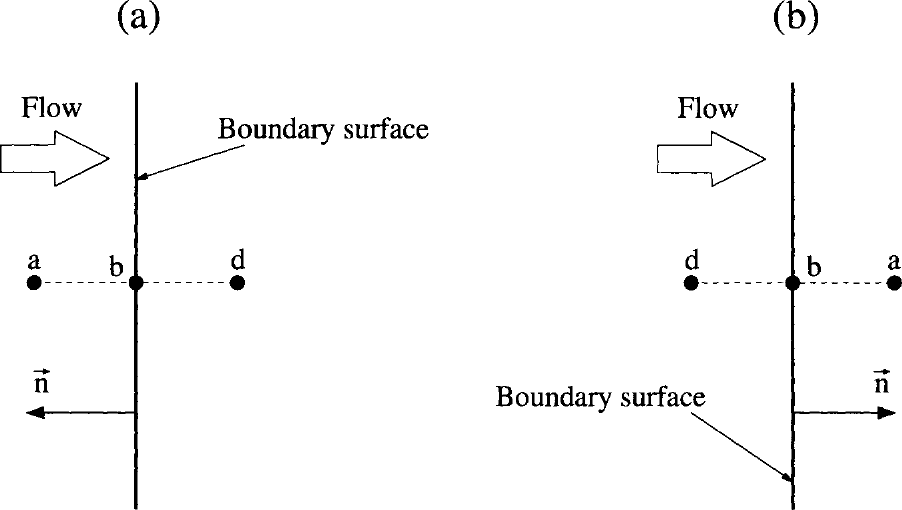
图8.6:远场边界:入流(a)与出流(b)情形。位置\(a\)在域外,\(b\)在边界上,位置\(d\)在物理域内。单位法向量\(\vec{n}=[n_x,n_y,n_z]^T\)指向域外。图例:Flow——流动;Boundary surface——边界面。
Supersonic Inflow 超声速入流
对于超声速入流,所有特征值同号。由于流动进入物理域,边界上(图8.6中的点\(b\))的守恒变量完全由自由来流值确定,即en
For supersonic inflow, all eigenvalues have the same sign. Since the flow is entering the physical domain, the conservative variables on the boundary (point \(b\) in Fig. 8.6) are determined by freestream values only. Thus,
\(\vec{W}_a\)的值根据给定的马赫数\(M_\infty\)和两个气流角(迎角、侧滑角)确定。en
The values \(\vec{W}_a\) are specified based on the given Mach number \(M_\infty\) and on two flow angles (angle of attack, side-slip angle).
Supersonic Outflow 超声速出流
这种情形下所有特征值同样同号。但此时流动离开物理域,边界上所有守恒变量都必须由域内的解确定,只需令en
In this case, all eigenvalues have also the same sign. However, the flow leaves now the physical domain and all conservative variables at the boundary must be determined from the solution inside the domain. This can be accomplished simply by setting
Subsonic Inflow 亚声速入流
此时,四条特征线进入、一条离开物理域。因此,四个特征变量根据自由来流值给定,一个特征变量由物理域内外推。由此得到下列边界条件[12]en
Here, four characteristics enter and one leaves the physical domain. Therefore, four characteristic variables are prescribed based on the freestream values. One characteristic variable is extrapolated from the interior of the physical domain. This leads to the following set of boundary conditions [12]
其中\(\rho_0\)和\(c_0\)表示一个参考状态。参考状态通常取为内点处(图8.6中的点\(d\))的状态。点\(a\)处的值由自由来流状态确定。en
where \(\rho_0\) and \(c_0\) represent a reference state. The reference state is normally set equal to the state at the interior point (point \(d\) in Fig. 8.6). The values in point \(a\) are determined from the freestream state.
Subsonic Outflow 亚声速出流
对于亚声速出流,四个流动变量(密度和三个速度分量)必须由物理域内部外推得到,余下的第五个变量(压力)必须从外部给定。远场边界处的原始变量由下式得到[12]en
In the case of subsonic outflow, four flow variables (density and the three velocity components) have to be extrapolated from the interior of the physical domain. The remaining fifth variable (pressure) must be specified externally. The primitive variables at the farfield boundary are obtained from [12]
其中\(p_a\)为给定的静压。en
with \(p_a\) being the prescribed static pressure.
虚单元中的物理量可由状态\(b\)和\(d\)线性外推得到。en
Physical properties in the dummy cells can be obtained by linear extrapolation from the states \(b\) and \(d\).