8.3 Farfield 远场[cfd-8-3]
绕翼型、机翼、汽车及其他外形的外流数值模拟必须在有界域内进行,因此人工远场边界条件成为必需。远场边界条件的数值实现须满足两个基本要求:第一,与无限域相比,求解域的截断不应对流动解产生明显影响;第二,任何向外传播的扰动都不得被反射回流场[9]。由于其椭圆性质,亚声速与跨声速流动问题对远场边界条件特别敏感。不当的实现会显著减慢向定常态的收敛,而且解的精度也很可能受到不利影响。人们已发展出多种能够在人工边界处吸收外传波的方法[10]-[15]。关于各种无反射边界条件的综述可见[16]。en
The numerical simulation of external flows past airfoils, wings, cars and other configurations has to be conducted within a bounded domain. For this reason, artificial farfield boundary conditions become necessary. The numerical implementation of the farfield boundary conditions has to fulfil two basic requirements. First, the truncation of the domain should have no notable effects on the flow solution as compared to the infinite domain. Second, any outgoing disturbances must not be reflected back into the flow field [9]. Due to their elliptic nature, sub- and transonic flow problems are particularly sensitive to the farfield boundary conditions. An inadequate implementation can lead to a significant slow down of convergence to the steady state. Furthermore, the accuracy of the solution is likely to be negatively influenced. Various methodologies were developed, which are capable of absorbing the outgoing waves at the artificial boundaries [10]-[15]. An review of different non-reflecting boundary conditions can be found in [16].
在下面两个小节中,我们将讨论Whitfield和Janus[12]所述的特征变量(characteristic variables)概念,并给出针对升力体的远场边界条件扩展。en
In the following two subsections, we shall discuss the concept of characteristic variables as it was described by Whitfield and Janus [12]. We shall also present an extension of the farfield boundary conditions for lifting bodies.
8.3.1 Concept of Characteristic Variables 特征变量的概念[cfd-8-3-1]
信息沿特征线流出或流入计算域,取决于对流通量雅可比矩阵特征值的符号(附录A.11,式(A.84)或(A.88))。例如,亚声速入流时有四条入射特征线(三维)和一条出射特征线(式(A.88)中的\(\lambda_5\));亚声速出流时情形正好相反。根据Kreiss的一维理论[17],在边界上从域外施加的条件数应等于入射特征线的条数,其余条件应由域内的解确定。en
Depending on the sign of the eigenvalues of the convective flux Jacobians (Appendix A.11, Eq. (A.84) or (A.88)), the information is transported out of or into the computational domain along the characteristics. For example, in the case of subsonic inflow there are four incoming characteristics (in 3D) and one outgoing (\(\lambda_5\) in Eq. (A.88)). The situation reverses for subsonic outflow. According to the one-dimensional theory of Kreiss [17], the number of conditions to be imposed from outside at the boundary should be equal to the number of incoming characteristics. The remaining conditions should be determined from the solution inside the domain.
Whitfield和Janus的方法[12]基于边界法向方向上Euler方程(2.45)的特征形式。实践表明,该方法在结构与非结构网格上对多种流动情形都表现很好。它不仅可用于远场边界,也可用于无黏固壁(小节8.2.1)。en
The approach of Whitfield and Janus [12] is based on the characteristic form of the Euler equations (2.45) normal to the boundary. The methodology was found to perform very well on structured and unstructured grids in a large variety of flow cases. It can be applied not only to farfield boundaries but also to inviscid solid walls (Subsection 8.2.1).
远场边界处的两种基本流动情形绘于图8.6。流动既可能进入也可能离开计算域。因此,依局部马赫数不同,需要处理四种不同类型的远场边界条件:
- 超声速入流;
- 超声速出流;
- 亚声速入流;
- 亚声速出流。
en
The two basic flow situations at the farfield boundary are sketched in Fig. 8.6. The flow can either enter or it can leave the domain. Therefore, depending on the local Mach number, four different types of farfield boundary conditions have to be treated:
- supersonic inflow,
- supersonic outflow,
- subsonic inflow, and
- subsonic outflow.
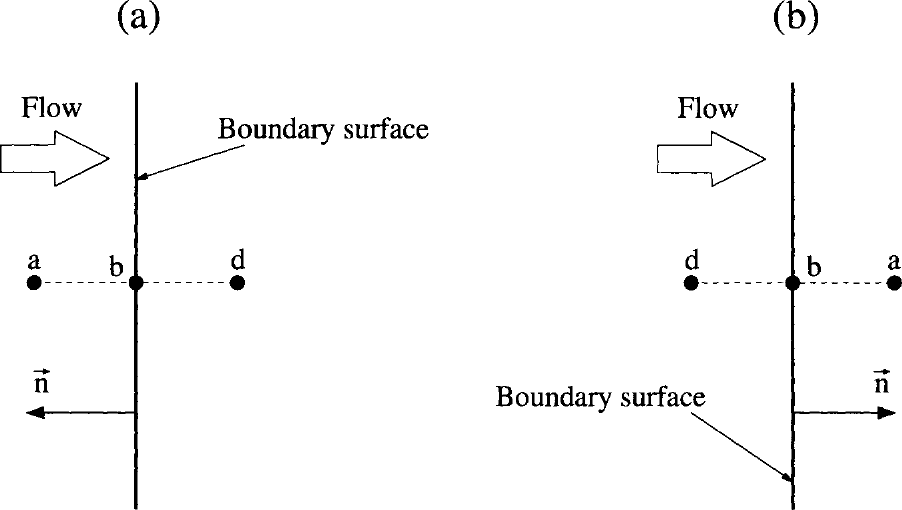
图8.6:远场边界:入流(a)与出流(b)情形。位置\(a\)在域外,\(b\)在边界上,位置\(d\)在物理域内。单位法向量\(\vec{n}=[n_x,n_y,n_z]^T\)指向域外。图例:Flow——流动;Boundary surface——边界面。
Supersonic Inflow 超声速入流
对于超声速入流,所有特征值同号。由于流动进入物理域,边界上(图8.6中的点\(b\))的守恒变量完全由自由来流值确定,即en
For supersonic inflow, all eigenvalues have the same sign. Since the flow is entering the physical domain, the conservative variables on the boundary (point \(b\) in Fig. 8.6) are determined by freestream values only. Thus,
\(\vec{W}_a\)的值根据给定的马赫数\(M_\infty\)和两个气流角(迎角、侧滑角)确定。en
The values \(\vec{W}_a\) are specified based on the given Mach number \(M_\infty\) and on two flow angles (angle of attack, side-slip angle).
Supersonic Outflow 超声速出流
这种情形下所有特征值同样同号。但此时流动离开物理域,边界上所有守恒变量都必须由域内的解确定,只需令en
In this case, all eigenvalues have also the same sign. However, the flow leaves now the physical domain and all conservative variables at the boundary must be determined from the solution inside the domain. This can be accomplished simply by setting
Subsonic Inflow 亚声速入流
此时,四条特征线进入、一条离开物理域。因此,四个特征变量根据自由来流值给定,一个特征变量由物理域内外推。由此得到下列边界条件[12]en
Here, four characteristics enter and one leaves the physical domain. Therefore, four characteristic variables are prescribed based on the freestream values. One characteristic variable is extrapolated from the interior of the physical domain. This leads to the following set of boundary conditions [12]
其中\(\rho_0\)和\(c_0\)表示一个参考状态。参考状态通常取为内点处(图8.6中的点\(d\))的状态。点\(a\)处的值由自由来流状态确定。en
where \(\rho_0\) and \(c_0\) represent a reference state. The reference state is normally set equal to the state at the interior point (point \(d\) in Fig. 8.6). The values in point \(a\) are determined from the freestream state.
Subsonic Outflow 亚声速出流
对于亚声速出流,四个流动变量(密度和三个速度分量)必须由物理域内部外推得到,余下的第五个变量(压力)必须从外部给定。远场边界处的原始变量由下式得到[12]en
In the case of subsonic outflow, four flow variables (density and the three velocity components) have to be extrapolated from the interior of the physical domain. The remaining fifth variable (pressure) must be specified externally. The primitive variables at the farfield boundary are obtained from [12]
其中\(p_a\)为给定的静压。en
with \(p_a\) being the prescribed static pressure.
虚单元中的物理量可由状态\(b\)和\(d\)线性外推得到。en
Physical properties in the dummy cells can be obtained by linear extrapolation from the states \(b\) and \(d\).
8.3.2 Modifications for Lifting Bodies 升力体情形的修正[cfd-8-3-2]
上述特征远场边界条件假设环量为零,这对亚声速或跨声速流动中的升力体并不正确。因此,远场边界必须放在离物体非常远的地方,否则流动解会不准确。如果自由来流中包含一个单独涡的影响(三维情形为马蹄涡),到远场的距离可以显著缩短(约一个数量级)。该涡假定位于升力体的中心,其强度与物体产生的升力成正比。下面我们给出涡修正的二维和三维实现。en
The above characteristic farfield boundary conditions assume zero circulation, which is not correct for a lifting body in sub- or transonic flow. For this reason, the farfield boundary has to be located very far away from the body. Otherwise, the flow solution will be inaccurate. The distance to the farfield can be significantly shortened (by one order of magnitude), if the freestream flow includes the effect of a single vortex (horse-shoe vortex in 3D). The vortex is assumed to be centred at the lifting body. The strength of the vortex is proportional to the lift produced by the body. In the following, we shall present implementations of the vortex correction in 2D and in 3D.
Vortex Correction in 2D 二维涡修正
这里要叙述的方法由Usab和Murman提出[18]。修正后自由来流速度的分量由下列表达式给出(假设可压缩流动)en
The approach, which we want to describe here, was suggested by Usab and Murman [18]. The components of the corrected freestream velocity are given by the expressions (compressible flow assumed)
其中\(\Gamma\)为环量,\((d,\theta)\)为远场点的极坐标,\(\alpha\)为迎角,\(M_\infty\)为自由来流马赫数。环量由下式求得en
with \(\Gamma\) being the circulation, \((d,\theta)\) the polar coordinates of the farfield point, \(\alpha\) the angle of attack, and \(M_\infty\) denoting the freestream Mach number, respectively. The circulation is obtained from
其中\(x_{ref}\)和\(y_{ref}\)为参考点(涡所在位置,例如1/4弦长处)的坐标。en
where \(x_{ref}\) and \(y_{ref}\) are the coordinates of the reference point (location of the vortex - e.g., at 1/4 chord).
修正后的自由来流压力\(p_\infty^{*}\)由下式给出en
The modified freestream pressure \(p_\infty^{*}\) is given by
其中\(\|\vec{v}_\infty^{*}\|_2^2=(u_\infty^{*})^2+(v_\infty^{*})^2\)。修正后的自由来流密度由状态方程得到en
with \(\|\vec{v}_\infty^{*}\|_2^2=(u_\infty^{*})^2+(v_\infty^{*})^2\). The corrected freestream density is obtained from the equation of the state
上述涡修正式(8.24)-(8.28)严格来说只对亚声速流动成立。不过,实践证明对自由来流条件的这一修正在跨声速流动中同样有帮助。图8.7展示了这方面的结果,其中研究了升力系数对远场边界距离的依赖关系。远场半径取为5、20、50和99倍弦长。可以看到,不加涡修正的模拟对远场距离有强烈的依赖性;相反,带涡的模拟在约20倍弦长的距离内仍保持足够精度。这使网格单元/点数显著减少。文献[19]证明,若在涡修正中使用更高阶的项,远场边界可以只放在约5倍弦长处而不损失精度。en
The above vortex correction Eqs. (8.24)-(8.28) is strictly valid for subsonic flow only. However, the modification of the freestream conditions proved to be helpful in transonic flow as well. This is demonstrated in Fig. 8.7, where the dependence of the lift coefficient on the distance to the farfield boundary was investigated. The farfield radius was set to 5, 20, 50, and 99 chords. As we can see, simulations without the vortex correction experiences a strong dependence on the farfield distance. On the contrary, simulations with the vortex remain sufficiently accurate up to a distance of about 20 chords. This leads to a significant reduction of the number of grid cells/points. It was demonstrated in Ref. [19] that by using higher-order terms in the vortex correction, the farfield boundary can be placed only about 5 chords away without loss of accuracy.
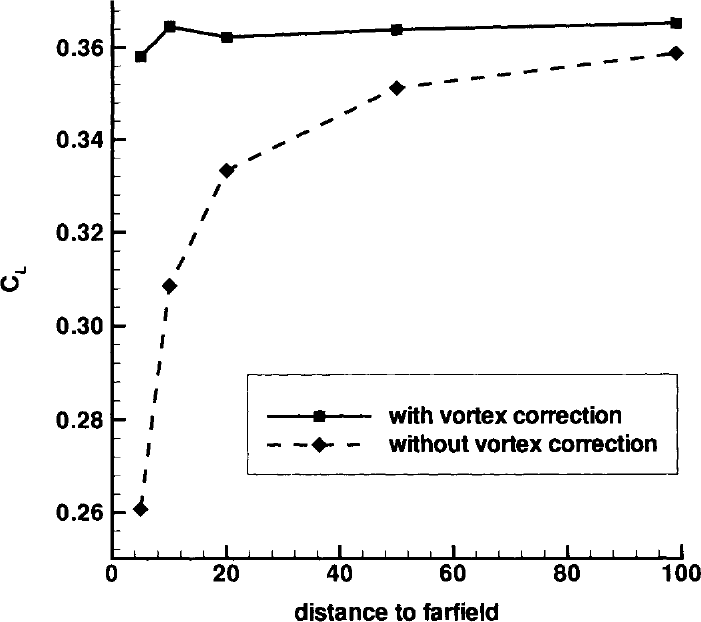
图8.7:到远场边界的距离和单个涡对升力系数的影响。NACA 0012翼型,\(M_\infty=0.8\),\(\alpha=1.25^{\circ}\)。图例:横轴distance to farfield——到远场的距离;纵轴\(C_L\)——升力系数;with vortex correction——带涡修正;without vortex correction——不带涡修正。
Vortex Correction in 3D 三维涡修正
机翼对远场边界的影响可以用马蹄涡来近似。对于可压缩流动,修正后的自由来流速度分量可由下式得到[20]、[21]en
The effect of a wing on the farfield boundary can be approximated by a horse-shoe vortex. In the case of compressible flow, the modified freestream velocity components can be obtained from [20], [21]
其中\(\Gamma\)表示环量,\((x,y,z)\)为远场点的笛卡儿坐标,\(l\)为半展长。此外,式(8.29)中假设流动沿正\(x\)方向,机翼沿\(z\)轴布置。式(8.29)中的\(\mathcal{A}\)、\(\mathcal{B}\)和\(\mathcal{C}\)为en
where \(\Gamma\) denotes the circulation, \((x,y,z)\) the Cartesian coordinates of the farfield point, and \(l\) stands for the half span, respectively. Furthermore, in Eq. (8.29) it was assumed that the flow is in the positive \(x\)-direction with the wing being oriented along the \(z\)-axis. The terms \(\mathcal{A}\), \(\mathcal{B}\) and \(\mathcal{C}\) in Eq. (8.29) read
其中缩写定义为en
The abbreviations are given by
其中\(M_\infty\)为自由来流马赫数。环量\(\Gamma\)仍用式(8.25)计算,此时\(a\)表示平均弦长。修正后的压力(\(p_\infty^{*}\))和密度(\(\rho_\infty^{*}\))分别由公式(8.27)和(8.28)求得。式(8.22)或式(8.23)中的\(u_a\)、\(v_a\)、\(w_a\)、\(p_a\)和\(\rho_a\)替换为其修正值\(u_\infty^{*}\)、\(v_\infty^{*}\)、\(w_\infty^{*}\)、\(p_\infty^{*}\)和\(\rho_\infty^{*}\)。en
with \(M_\infty\) being the freestream Mach number. The circulation \(\Gamma\) is calculated using Eq. (8.25), where \(a\) represents the mean chord. The corrected values of pressure (\(p_\infty^{*}\)) and of density (\(\rho_\infty^{*}\)) are obtained from the formulae (8.27) and (8.28), respectively. The quantities \(u_a\), \(v_a\), \(w_a\), \(p_a\), and \(\rho_a\) in Eq. (8.22) or Eq. (8.23) are replaced by their corrected values \(u_\infty^{*}\), \(v_\infty^{*}\), \(w_\infty^{*}\), \(p_\infty^{*}\), and \(\rho_\infty^{*}\).
以及\(x=x_{farf}\)。为避免数值奇性,文献[21]建议把en
and \(x=x_{farf}\). In order to avoid the numerical singularity, in Ref. [21] it was suggested to constrain the values of
在式(8.29)中的取值限制在1/4展长,即\(l/2\)以内。这一措施把涡线\(z=l\)和\(z=-l\)周围\(l/2\)距离内对速度\(v_\infty\)和\(w_\infty\)的修正量减小。en
in Eq. (8.29) to the 1/4 wingspan, i.e., \(l/2\). This measure reduces the corrections to the velocities \(v_\infty\) and \(w_\infty\) within the distance \(l/2\) around the vortex lines \(z=l\) and \(z=-l\).
文献[21]给出的数值结果表明,应用式(8.29)的涡修正后,升力系数和阻力系数对远场距离的敏感性降低。研究发现,到远场边界\(7\cdot l\)的距离足以获得准确的结果。en
The numerical results presented in [21] indicate a reduced sensitivity of the lift and drag coefficient with respect to the farfield distance, if the vortex correction in Eq. (8.29) is applied. It was found that a distance of \(7\cdot l\) to the farfield boundary is sufficient for accurate results.