4.2.4 Cell-Centred versus Cell-Vertex Schemes 单元中心格式与单元顶点格式的对比[cfd-4-2-4]
在前面三小节中ï¼我们概述了单元中心与单元顶点两种离散方法学。下面几段将对这三种格式进行比较ï¼并概述围绕它们相对优劣的、有时颇具争议的讨论。en
In the preceding three subsections, both the cell-centred and the cell-vertex discretisation methodologies were outlined. The following paragraphs compare the three schemes and give an overview of the, at times controversial, debate about their relative merits.
首先ï¼考察离散化的精度。由文献[4]、[21]中的讨论可知ï¼单元顶点格式(无论采用重叠控制体还是对偶控制体)在扭曲网格上只能做到一阶精度。在笛卡尔网格或光滑网格(即相邻单元的体积变化不大、扭曲轻微的网格)上ï¼单元顶点格式按通量计算格式的不同可达到二阶或更高精度[22]。相反ï¼单元中心格式的离散误差在很大程度上取决于网格的光滑程度。例如ï¼对于图4.7所示的单元布置ï¼即使是线性变化的函数ï¼取平均也不能给出面上中点的正确值。其后果是:在具有斜率间断的网格上ï¼即使把网格无限细化ï¼离散误差也不会减小。如文献[4]所证明的ï¼这类零阶误差表现为等值线上的振荡或扭折ï¼而单元顶点格式在同一情形下不会遇到任何问题。尽管如此ï¼在笛卡尔网格或充分光滑的网格上ï¼单元中心格式同样可以达到二阶或更高精度。文献[23]-[26]对离散误差作了进一步分析。en
First, let us consider the accuracy of the discretisations. It follows from the discussion in [4], [21] that the cell-vertex scheme (either with overlapping or dual control volumes) can be made first-order accurate on distorted grids. On Cartesian or on smooth grids (i.e., where the volumes between adjacent cells vary only moderately and which are only slightly skewed), the cell-vertex scheme is second- or higher-order accurate [22], depending on the flux evaluation scheme. In the opposite, the discretisation error of a cell-centred scheme depends strongly on the smoothness of the grid. For example, for an arrangement of the cells sketched in Fig. 4.7, an averaging does not provide the correct value at the midpoint of a face even for a linearly varying function. The consequence is that on a grid with slope discontinuity the discretisation error will not be reduced even when the grid is infinitely refined. As demonstrated in [4], such zero-order errors manifest themselves as oscillations or kinks in isolines, whereas a cell-vertex scheme experiences no problems in the same situation. Nevertheless, on Cartesian or on sufficiently smooth grids, the cell-centred scheme can also reach second- or higher-order accuracy. A further analysis of the discretisation errors were presented in [23]-[26].
其次ï¼比较三种方法及其在边界处的特性。采用对偶控制体的单元顶点格式主要在固壁边界处遇到困难。再次回顾图4.6即可明显看出ï¼在边界处控制体只剩大约一半。沿各面对通量积分得到的残差位于控制体内部——理想情况下位于其形心;但残差却被关联到直接位于壁面上的节点。与单元中心格式相比ï¼这种错位导致离散误差增大。对偶控制体的定义在尖角(如尾缘)处也会引起问题ï¼表现为压力或密度上的非物理峰值。此外ï¼在坐标切割或周期边界(见第8章)等处还会出现更多复杂情况ï¼在那里必须把来自控制体两部分的通量正确地相加en
Second, let us compare the three methods and their characteristics at boundaries. It is mainly at the solid wall boundary where the cell-vertex scheme with dual control volumes faces difficulties. Recalling Fig. 4.6 again, it is apparent that only about one half of the control volume is left at the boundary. The integration of fluxes around the faces results in a residual located inside - ideally in the centroid - of the control volume. But, the residual is associated with the node residing directly at the wall. This mismatch leads to increased discretisation error in comparison to the cell-centred scheme. The definition of the dual control volume causes also problems at sharp corners (like trailing edges), which show up as unphysical peaks in pressure or density. Further complications arise, e.g., at coordinate cuts or at periodic boundaries (see Chapter 8), where the fluxes from both parts of the control volume have to be summed
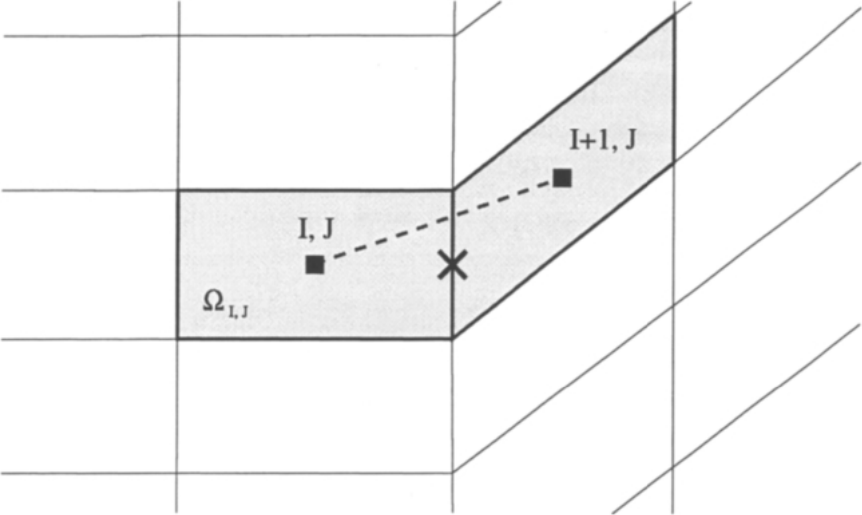
图4.7:斜扭曲网格上的单元中心通量平衡;叉号表示单元面的中点。图例:阴影四边形\(\Omega_{I,J}\)为控制体ï¼其右侧相邻单元\(I+1,J\)发生扭斜;两个单元形心以实心方块标记ï¼虚线连接两形心;叉号\(\times\)表示两单元公共面的中点——即使是线性变化的函数ï¼由形心处数值取平均也得不到该点的正确值。
才行。所有单元顶点格式还需要额外的逻辑ï¼以保证在由多个网格块共享的边界点上解的一致性。单元中心格式则不存在这些问题。en
up correctly. All cell-vertex schemes also require additional logic, in order to assure a consistent solution at boundary points shared by multiple grid blocks. No such problems appear for cell-centred schemes.
采用重叠控制体的单元顶点格式在壁面边界的处理上比对偶体积格式有利ï¼但它不能与流行的上风离散方法(如TVD、AUSM或CUSP)结合使用。其离散所涉及的点多于单元中心格式与对偶控制体格式(三维中为27个而非7个)ï¼这会导致间断被抹平ï¼并且在隐式时间离散的情形下带来内存开销。en
The cell-vertex scheme with overlapping control volumes has an advantage over the dual volume scheme in the treatment of wall boundaries, but it cannot be combined with the popular upwind discretisation methods like TVD, AUSM, or CUSP. The discretisation involves more points than those of the cell-centred and the dual control-volume schemes (27 instead of 7 in 3D), which leads to smearing of discontinuities and memory overhead in the case of an implicit time discretisation.
单元中心格式与单元顶点格式之间的最后一个主要差别出现在非定常流动问题中。正如3.2节中早已提到的ï¼单元顶点格式至少需要对质量矩阵[27]、[28]作近似处理。相反ï¼在单元中心格式中ï¼质量矩阵可以完全舍弃ï¼因为残差自然地与控制体的形心相关联。en
The last main difference between the cell-centred and the cell-vertex schemes appears for unsteady flow problems. As mentioned earlier in Section 3.2, the cell-vertex schemes require at least an approximate treatment of the mass matrix [27], [28]. On the contrary, the mass matrix can be completely discarded in the case of a cell-centred scheme, because the residual is naturally associated with the centroid of the control volume.
总之ï¼采用对偶控制体的单元顶点格式与单元中心格式在定常流场内部的数值特性非常相似。主要差别出现在扭曲网格、边界处理以及非定常流动等情形。在后两种情形中ï¼单元中心方法相对单元顶点格式表现出优势ï¼使得它在流动求解器中的实现更为直接。en
In summary, the cell-vertex scheme with dual control volumes and the cell-centred scheme are numerically very similar in the interior of a stationary flow field. The main differences occur on distorted grids, in the boundary treatment and for unsteady flows. In the last two cases, the cell-centred approach shows advantages over the cell-vertex schemes, which result in a more straightforward implementation in a flow solver.