3.1.2 Finite Volume Method 有限体积法[cfd-3-1-2]
有限体积法直接利用守恒定律——即 Navier-Stokes/Euler 方程的积分形式。它由 McDonald[44]首先用于二维无黏流动的模拟。有限体积法离散控制方程的做法是:先把物理空间划分成若干任意多面体控制体ï¼然后用穿过控制体各个面的通量之和来近似式(2.19)右端的面积分。空间离散的精度取决于计算通量所用的具体格式。en
The finite volume method directly utilises the conservation laws - the integral formulation of the Navier-Stokes/Euler equations. It was first employed by McDonald [44] for the simulation of 2-D inviscid flows. The finite volume method discretises the governing equations by first dividing the physical space into a number of arbitrary polyhedral control volumes. The surface integral on the right-hand side of Equation (2.19) is then approximated by the sum of the fluxes crossing the individual faces of the control volume. The accuracy of the spatial discretisation depends on the particular scheme with which the fluxes are evaluated.
相对于网格ï¼控制体的形状与位置有几种不同的定义方式。可以区分出两种基本途径:
- 格心格式(cell-centred scheme)(图3.6a)——流动量存储在网格单元的形心处ï¼因此控制体与网格单元完全重合。
- 格点格式(cell-vertex scheme)(图3.6b)——流动变量存储在网格点上。此时控制体既可以取共享该网格点的所有单元的并集ï¼也可以取围绕该网格点居中的某个体积。前者称为重叠型控制体(overlapping control volumes)ï¼后者称为对偶控制体(dual control volumes)。
en
There are several possibilities of defining the shape and position of the control volume with respect to the grid. Two basic approaches can be distinguished:
- Cell-centred scheme (Fig. 3.6a) - here the flow quantities are stored at the centroids of the grid cells. Thus, the control volumes are identical to the grid cells.
- Cell-vertex scheme (Fig. 3.6b) - here the flow variables are stored at the grid points. The control volume can then either be the union of all cells sharing the grid point, or some volume centred around the grid point. In the former case we speak of overlapping control volumes, in the second case of dual control volumes.
我们将在后面两章讨论空间离散的内容时ï¼再详细比较格心与格点两种表述的优缺点。en
We shall discuss the advantages and disadvantages of cell-centred and cell-vertex formulations in both chapters on spatial discretisation.
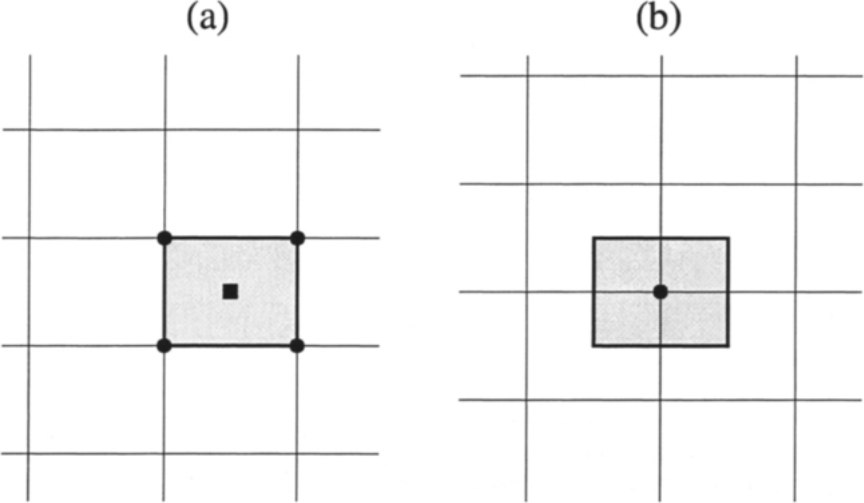
图3.6:格心格式(a)与格点格式(b)(对偶控制体)的控制体。图例:(a)中阴影四边形为控制体ï¼其四个角点(实心圆点)为网格点ï¼形心处的实心方块表示流动量的存储位置;(b)中阴影四边形为围绕中心网格点(实心圆点)的对偶控制体。
有限体积法的主要优点在于空间离散直接在物理空间中进行。因此ï¼不会像有限差分法那样遇到物理坐标系与计算坐标系之间的任何变换问题。与有限差分相比ï¼有限体积法的另一个优点是非常灵活——它既可以相当容易地在结构网格上实现ï¼也可以在非结构网格上实现。这使得有限体积法特别适合处理复杂几何中的流动。en
The main advantage of the finite volume method is that the spatial discretisation is carried out directly in the physical space. Thus, there are no problems with any transformation between the physical and the computational coordinate system, like in the case of the finite difference method. Compared to the finite differences, one further advantage of the finite volume method is that it is very flexible - it can be rather easily implemented on structured as well as on unstructured grids. This renders the finite volume method particularly suitable for the treatment of flows in complex geometries.
由于有限体积法基于对守恒定律的直接离散ï¼数值格式也使质量、动量和能量保持守恒。由此得到该方法的另一个重要特性ï¼即能够正确计算控制方程的弱解(weak solutions)。不过ï¼对于 Euler 方程还须满足一个附加条件ï¼即所谓的熵条件(entropy condition)。它之所以必要ï¼是因为弱解不唯一。熵条件可防止出现膨胀激波这类违反热力学第二定律(熵减小)的非物理现象。作为守恒离散的进一步结果ï¼跨越解的间断(如激波或接触间断)必须成立的 Rankine-Hugoniot 关系被直接满足。en
Since the finite volume method is based on the direct discretisation of the conservation laws, mass, momentum and energy are also conserved by the numerical scheme. This leads to another important feature of the method, namely the ability to compute weak solutions of the governing equations correctly. However, one additional condition has to be fulfilled in the case of the Euler equations. This is known as the entropy condition. It is necessary because of the non-uniqueness of the weak solutions. The entropy condition prevents the occurrence of unphysical features like expansion shocks, which violate the second law of thermodynamics (decrease of the entropy). As a further consequence of the conservative discretisation, the Rankine-Hugoniot relations, which must hold across a solution discontinuity (such as a shockwave or a contact discontinuity), are satisfied directly.
有趣的是ï¼在一定条件下可以证明有限体积法等价于有限差分法或低阶有限元法。凭借其吸引人的特性ï¼有限体积法如今广受欢迎、应用广泛。后续各章将对其进行介绍。en
It is interesting to note that under certain conditions, the finite volume method can be shown to be equivalent to the finite difference method, or to a low-order finite element method. Because of its attractive properties, the finite volume method is nowadays very popular and in wide use. It will be presented in the following chapters.