2.3 Viscous Stresses 黏性应力[cfd-2-3]
黏性应力源于流体与微元表面之间的摩擦,由应力张量\(\overline{\overline{\tau}}\)描述。在笛卡尔坐标系中,其一般形式为en
The viscous stresses, which originate from the friction between the fluid and the surface of an element, are described by the stress tensor \(\overline{\overline{\tau}}\). In Cartesian coordinates its general form is given by
按照惯例,记号\(\tau_{ij}\)表示该应力分量作用在垂直于\(i\)轴的平面上、方向沿\(j\)轴。分量\(\tau_{xx}\)、\(\tau_{yy}\)和\(\tau_{zz}\)代表法向应力,\(\overline{\overline{\tau}}\)的其余分量则分别代表切向应力。图2.3给出了四边形流体微元上的应力。可以看到,法向应力(图2.3a)试图使微元的各个面沿三个互相垂直的方向发生位移,而切向应力(图2.3b)则试图使微元发生剪切变形。en
The notation \(\tau_{ij}\) means by convention that the particular stress component affects a plane perpendicular to the \(i\)-axis, in the direction of the \(j\)-axis. The components \(\tau_{xx}\), \(\tau_{yy}\), and \(\tau_{zz}\) represent the normal stresses, the other components of \(\overline{\overline{\tau}}\) stand for the shear stresses, respectively. Figure 2.3 shows the stresses for a quadrilateral fluid element. One can notice that the normal stresses (Fig. 2.3a) try to displace the faces of the element in three mutually perpendicular directions, whereas the shear stresses (Fig. 2.3b) try to shear the element.
现在你可能会问,黏性应力是如何求得的。首先,它们取决于介质的动力学性质。对于空气或水这类流体,Isaac Newton指出切向应力与速度梯度成正比。因此,这类介质被称为牛顿流体(Newtonian fluid)。另一方面,诸如熔融塑料或血液等流体则表现出不同的行为——它们是非牛顿流体。但是,对于流体可以假设为牛顿流体的绝大多数实际问题,黏性应力张量的分量由如下关系定义[3], [4]en
You may ask now, how the viscous stresses are evaluated. First of all, they depend on the dynamical properties of the medium. For fluids like air or water, Isaac Newton stated that the shear stress is proportional to the velocity gradient. Therefore, medium of such a type is designated as Newtonian fluid. On the other hand, fluids like for example melted plastic or blood behave in a different manner - they are non-Newtonian fluids. But, for the vast majority of practical problems, where the fluid can be assumed to be Newtonian, the components of the viscous stress tensor are defined by the relations [3], [4]
其中\(\lambda\)为第二黏性系数(second viscosity),\(\mu\)为动力黏性系数(dynamic viscosity)。为方便起见,还可以定义所谓的运动黏性系数(kinematic viscosity),其公式为en
in which \(\lambda\) represents the second viscosity coefficient, and \(\mu\) denotes the dynamic viscosity coefficient. For convenience, we can also define the so-called kinematic viscosity coefficient, which is given by the formula
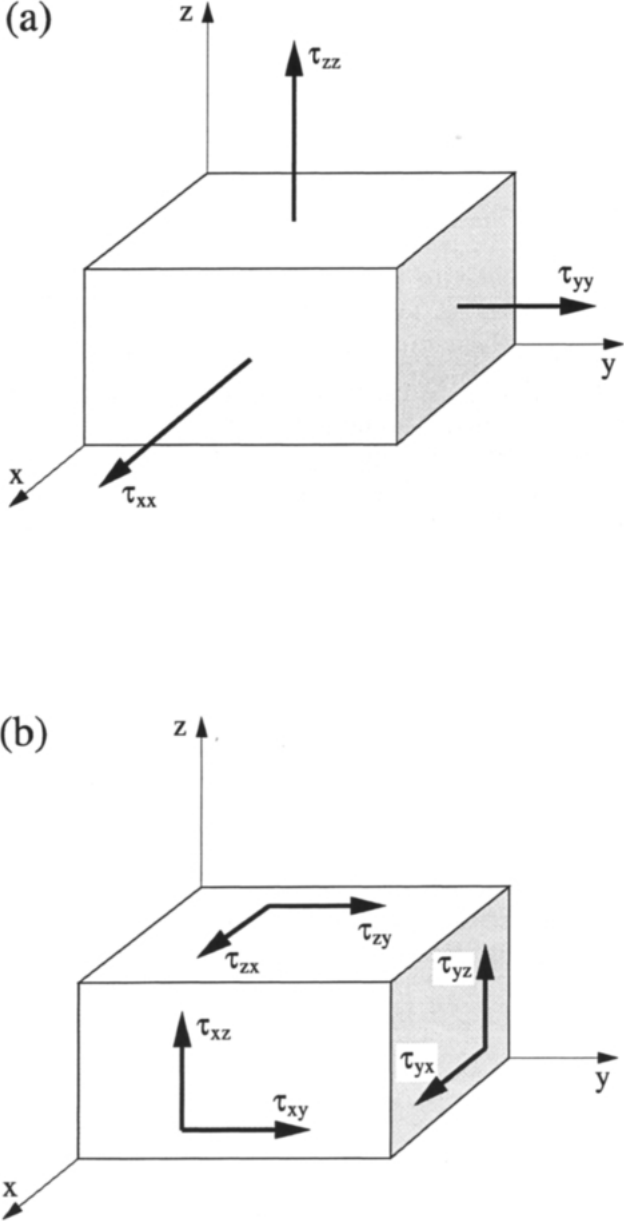
图2.3:作用在有限流体微元上的法向应力(a)与切向应力(b)。图例:(a)法向应力\(\tau_{xx}\)、\(\tau_{yy}\)、\(\tau_{zz}\);(b)切向应力\(\tau_{xy}\)、\(\tau_{xz}\)、\(\tau_{yx}\)、\(\tau_{yz}\)、\(\tau_{zx}\)、\(\tau_{zy}\)。
方程(2.15)中的表达式由英国人George Stokes在19世纪中叶导出。法向应力中的\(\mu(\partial u/\partial x)\)等项代表线膨胀率(linear dilatation)——形状的变化。另一方面,方程(2.15)中的项\((\lambda\,\mathrm{div}\,\vec{v})\)代表体积膨胀(volumetric dilatation)——体积的变化率,其本质是密度的变化。en
The expressions in Eq. (2.15) were derived by the Englishman George Stokes in the middle of the 19th century. The terms \(\mu(\partial u/\partial x)\), etc. in the normal stresses represent the rate of linear dilatation - a change in shape. On the other hand, the term \((\lambda\,\mathrm{div}\,\vec{v})\) in Eq. (2.15) represents volumetric dilatation - the rate of change in volume, which is in essence a change of the density.
除极高温度或极高压力的情形外,迄今尚无实验证据表明方程(2.17)中的Stokes假设不成立(参见文献[6]中的讨论)。因此,通常利用该假设从方程(2.15)中消去\(\lambda\)。于是,法向黏性应力为en
With the exception of extremely high temperatures or pressures, there is so far no experimental evidence that Stokes's hypothesis in Eq. (2.17) does not hold (see discussion in Ref. [6]). It is therefore generally used to eliminate \(\lambda\) from Eq. (2.15). Hence, we obtain for the normal viscous stresses
尚待确定的是作为流体状态函数的黏性系数\(\mu\)和热导率系数\(k\)。在连续介质力学的框架内,这只能依靠经验假设来完成。我们将在下一节回到这一问题。en
What remains to be determined are the viscosity coefficient \(\mu\) and the thermal conductivity coefficient \(k\) as functions of the state of the fluid. This can be done within the framework of continuum mechanics only on the basis of empirical assumptions. We shall return to this problem in the next section.