2.2.2 The Momentum Equation 动量方程[cfd-2-2-2]
动量方程的推导可以从牛顿第二定律的一种特定形式入手,该定律指出,动量的变化是由作用在质量微元上的净力引起的。对控制体\(\Omega\)中无限小部分(见图2.1)的动量,我们有en
We may start the derivation of the momentum equation by recalling the particular form of Newton's second law which states that the variation of momentum is caused by the net force acting on an mass element. For the momentum of an infinitesimally small portion of the control volume \(\Omega\) (see Fig. 2.1) we have
控制体内动量随时间的变化等于en
The variation in time of momentum within the control volume equals
因此,这里的守恒量是密度与速度的乘积,即en
Hence, the conserved quantity is here the product of the density and the velocity, i.e.,
描述动量越过控制体边界输运的对流通量张量,在笛卡尔坐标系中由以下三个分量组成en
The convective flux tensor, which describes the transfer of momentum across the boundary of the control volume, consists in the Cartesian coordinate system of the following three components
对流通量张量对动量守恒的贡献则由下式给出en
The contribution of the convective flux tensor to the conservation of momentum is then given by
扩散通量为零,因为对静止流体而言不可能存在动量的扩散。于是,剩下的问题是:流体微元受到哪些力的作用?我们可以辨识出作用在控制体上的两类力:
- 外部体积力或体力(body forces),直接作用在体积的质量上。例如重力、浮力、科里奥利力或离心力。在某些情形下,还可能存在电磁力。
- 表面力(surface forces),直接作用在控制体的表面上。它们仅来自两个来源:
- 由包围该体积的外部流体施加的压力分布;
- 由流体与体积表面之间的摩擦产生的切向应力和法向应力。
en
- 由包围该体积的外部流体施加的压力分布;
- 由流体与体积表面之间的摩擦产生的切向应力和法向应力。
The diffusive flux is zero since there is no diffusion of momentum possible for a fluid at rest. Thus, the remaining question is now, what are the forces the fluid element is exposed to? We can identify two kinds of forces acting on the control volume:
- External volume or body forces, which act directly on the mass of the volume. These are for example gravitational, buoyancy, Coriolis or centrifugal forces. In some cases, there can be electromagnetic forces present as well.
- Surface forces, which act directly on the surface of the control volume. They result from only two sources:
- the pressure distribution, imposed by the outside fluid surrounding the volume,
- the shear and normal stresses, resulting from the friction between the fluid and the surface of the volume.
由此可以看出,单位体积上的体力(下面记作\(\rho\vec{f}_e\))对应于方程(2.2)中的体积源。因此,体力(外力)对动量守恒的贡献为en
From the above, we can see that the body force per unit volume, further denoted as \(\rho\vec{f}_e\), corresponds to the volume sources in Eq. (2.2). Thus, the contribution of the body (external) force to the momentum conservation is
面源则由两部分组成——各向同性的压力分量和黏性应力(viscous stress)张量\(\overline{\overline{\tau}}\),即en
The surface sources consist then of two parts - of an isotropic pressure component and of a viscous stress tensor \(\overline{\overline{\tau}}\), i.e.,
其中\(\overline{\overline{I}}\)为单位张量(关于张量可参见例如[2])。面源对控制体的作用示于图2.2。在2.3节中,我们将更详细地阐述应力张量的形式,特别是说明法向应力和切向应力与流动速度之间的联系。en
with \(\overline{\overline{I}}\) being the unit tensor (for tensors see, e.g., [2]). The effect of the surface sources on the control volume is sketched in Fig. 2.2. In Section 2.3, we shall elaborate the form of the stress tensor in more detail, and in particular show how the normal and the shear stresses are connected to the flow velocity.
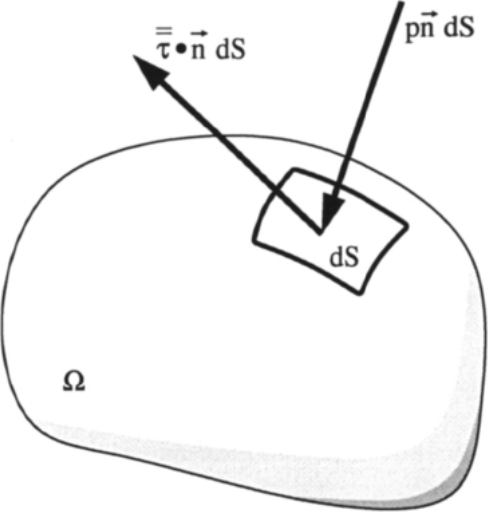
图2.2:作用在控制体表面元上的表面力。图例:\(\overline{\overline{\tau}}\cdot\vec{n}\,dS\)——黏性应力;\(p\vec{n}\,dS\)——压力;\(dS\)——面元;\(\Omega\)——控制体。
即固定在空间中的任意控制体\(\Omega\)内的动量守恒。en
for the momentum conservation inside an arbitrary control volume \(\Omega\) which is fixed in space.