2.1 The Flow and its Mathematical Description 流动及其数学描述[cfd-2-1]
在开始推导描述流体行为的基本方程之前,先澄清“流体动力学(fluid dynamics)”这一术语的含义可能会更方便。实际上,它研究的是大量单个粒子之间的相互作用运动,在这里这些粒子就是分子或原子。这意味着,我们假定流体的密度足够高,以致可以把它近似为连续介质(continuum)。也就是说,即使是微分意义下无限小的流体微元,也仍然包含足够多的粒子,从而可以为其指定平均速度和平均动能。这样,我们就能够在流体的每一点上定义速度、压力、温度、密度以及其他重要物理量。en
Before we begin with the derivation of the basic equations describing the behaviour of the fluid, it may be convenient to clarify what the term 'fluid dynamics' stands for. It is, in fact, the investigation of the interactive motion of a large number of individual particles. These are in our case molecules or atoms. That means, we assume the density of the fluid is high enough, so that it can be approximated as a continuum. It implies that even an infinitesimally small (in the sense of differential calculus) element of the fluid still contains a sufficient number of particles, for which we can specify mean velocity and mean kinetic energy. In this way, we are able to define velocity, pressure, temperature, density and other important quantities at each point of the fluid.
流体动力学基本方程的推导基于这样一个事实:流体的动力学行为由以下守恒定律(conservation laws)决定,即:
- 质量守恒;
- 动量守恒;
- 能量守恒。
en
The derivation of the principal equations of fluid dynamics is based on the fact that the dynamical behaviour of a fluid is determined by the following conservation laws, namely:
- the conservation of mass,
- the conservation of momentum, and
- the conservation of energy.
某一流动量的守恒,意味着它在任意体积内部的总变化,可以表示为以下几方面的净效应:越过边界被输运的该量、体积内部可能存在的内力和源,以及作用在该体积上的外力。越过边界的该量之数量称为通量(flux)。通量一般可以分解为两个不同的部分:一个源于对流输运,另一个源于静止流体中存在的分子运动。后一部分具有扩散性质——它与所考虑物理量的梯度成正比,因此在均匀分布时为零。en
The conservation of a certain flow quantity means that its total variation inside an arbitrary volume can be expressed as the net effect of the amount of the quantity being transported across the boundary, of any internal forces and sources, and of external forces acting on the volume. The amount of the quantity crossing the boundary is called flux. The flux can be in general decomposed into two different parts: one due to the convective transport and the other one due to the molecular motion present in the fluid at rest. This second contribution is of a diffusive nature - it is proportional to the gradient of the quantity considered, and hence it will vanish for a homogeneous distribution.
对守恒定律的讨论很自然地引导我们产生这样一个想法:把流场划分成许多体积,并集中研究流体在其中某一个有限区域内的行为。为此,我们定义所谓的有限控制体(finite control volume),并试图对其物理性质建立数学描述。en
The discussion of the conservation laws leads us quite naturally to the idea of dividing the flow field into a number of volumes and to concentrate on the modelling of the behaviour of the fluid in one such finite region. For this purpose, we define the so-called finite control volume and try to develop a mathematical description of its physical properties.
Finite control volume 有限控制体
考察图2.1中以流线表示的一个一般流场。流场中由封闭曲面\(\partial\Omega\)所包围、固定在空间中的一个任意有限区域,定义了控制体\(\Omega\)。我们还引入面元\(dS\)及其相应的、指向外侧的单位法向量\(\vec{n}\)。en
Consider a general flow field as represented by streamlines in Fig. 2.1. An arbitrary finite region of the flow, bounded by the closed surface \(\partial\Omega\) and fixed in space, defines the control volume \(\Omega\). We also introduce a surface element \(dS\) and its associated, outward pointing unit normal vector \(\vec{n}\).
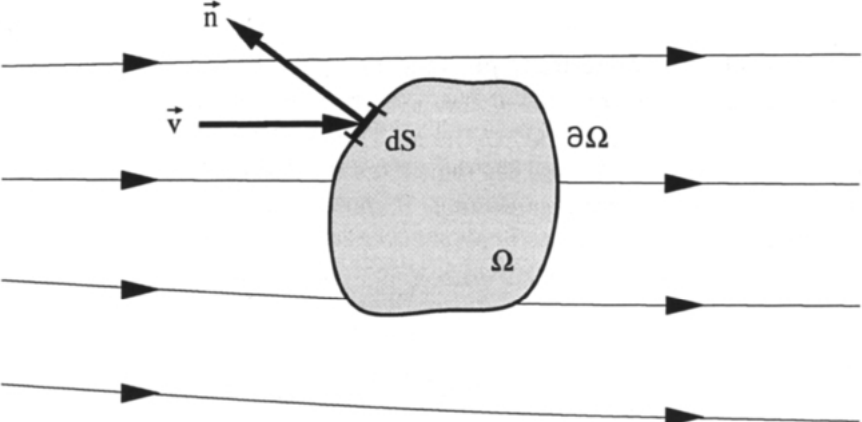
图2.1:有限控制体的定义(固定于空间中)。图例:流线;\(\Omega\)——控制体;\(\partial\Omega\)——控制体边界(封闭曲面);\(dS\)——面元;\(\vec{n}\)——外指单位法向量;\(\vec{v}\)——流动速度。
将守恒定律应用于单位体积上某个示例标量\(U\),则它在\(\Omega\)内随时间的变化,即en
The conservation law applied to an exemplary scalar quantity per unit volume \(U\) says that its variation in time within \(\Omega\), i.e.,
等于下列各项贡献之和:由对流通量(convective flux)引起的贡献——即以速度\(\vec{v}\)通过边界进入控制体的物理量\(U\)的数量en
is equal to the sum of the contributions due to the convective flux - amount of the quantity \(U\) entering the control volume through the boundary with the velocity \(\vec{v}\)
再加上由扩散通量(diffusive flux)引起的贡献——它由广义的Fick梯度定律表示en
further due to the diffusive flux - expressed by the generalised Fick's gradient law
其中\(\kappa\)为热扩散率系数(thermal diffusivity coefficient);最后还有体积源和面源\(Q_V\)、\(\vec{Q}_S\)的贡献,即en
where \(\kappa\) is the thermal diffusivity coefficient, and finally due to the volume as well as surface sources, \(Q_V\), \(\vec{Q}_S\), i.e.,
把上述各项贡献相加,便得到标量\(U\)的守恒定律的如下一般形式en
After summing up the above contributions, we obtain the following general form of the conservation law for the scalar quantity \(U\)
其中\(U^{*}\)表示单位质量的物理量\(U\),即\(U/\rho\)。en
where \(U^{*}\) denotes the quantity \(U\) per unit mass, i.e., \(U/\rho\).
值得注意的是,如果守恒量不是标量而是向量,上述方程(2.1)在形式上仍然成立。但不同之处在于,对流通量和扩散通量将不再是向量,而是变为张量——\(\overline{\overline{F}}_C\)为对流通量张量(convective flux tensor),\(\overline{\overline{F}}_D\)为扩散通量张量(diffusive flux tensor)。体积源将成为向量\(\vec{Q}_V\),而面源则变为张量\(\overline{\overline{Q}}_S\)。因此,对于一般向量量\(\vec{U}\),可以把守恒定律写成en
It is important to note that if the conserved quantity would be a vector instead of a scalar, the above Equation (2.1) would be formally still valid. But in difference, the convective and the diffusive flux would become tensors instead of vectors - \(\overline{\overline{F}}_C\) the convective flux tensor and \(\overline{\overline{F}}_D\) the diffusive flux tensor. The volume sources would be a vector \(\vec{Q}_V\), and the surface sources would change into a tensor \(\overline{\overline{Q}}_S\). We can therefore write the conservation law for a general vector quantity \(\vec{U}\) as
由方程(2.1)或(2.2)给出的守恒定律积分形式(integral formulation)具有两个非常重要且十分理想的性质:
- 若不存在体积源,\(U\)的变化仅取决于通过边界\(\partial\Omega\)的通量,而与控制体\(\Omega\)内部的任何通量无关;
- 当流场中存在激波或接触间断等间断时,这一特定形式仍然有效[1]。
en
The integral formulation of the conservation law, as given by the Equations (2.1) or (2.2), has two very important and desirable properties:
- if there are no volume sources present, the variation of \(U\) depends solely on the flux across the boundary \(\partial\Omega\) and not on any flux inside the control volume \(\Omega\);
- this particular form remain valid in the presence of discontinuities in the flow field like shocks or contact discontinuities [1].
由于其一般性和这些理想的性质,如今大多数CFD代码都基于控制方程的积分形式,这并不令人意外。en
Because of its generality and its desirable properties, it is not surprising that the majority of the CFD codes today is based on the integral form of the governing equations.
在下一节中,我们将利用上述积分形式,来导出流体动力学三个守恒定律的相应表达式。en
In the following section, we shall utilise the above integral form in order to derive the corresponding expressions for the three conservation laws of the fluid dynamics.